Democracy in China: Beijing Subway to be Completed in 3015?
There is no lack of mind-blowing statistics about China:
- Twenty million trees are cut every year to meet Chinese demand for chopsticks;
- By 2025, China will build enough skyscrapers to fill ten New York-sized cities;
- China has more than 800,000 millionaires (in US Dollars);
- Chinese consume 50,000 cigarettes every second;
- China has 64 million vacant homes, including entire cities that are empty;
- China’s economy grew seven times as fast as America’s over the first decade of this millennium (316% growth vs. 43%).
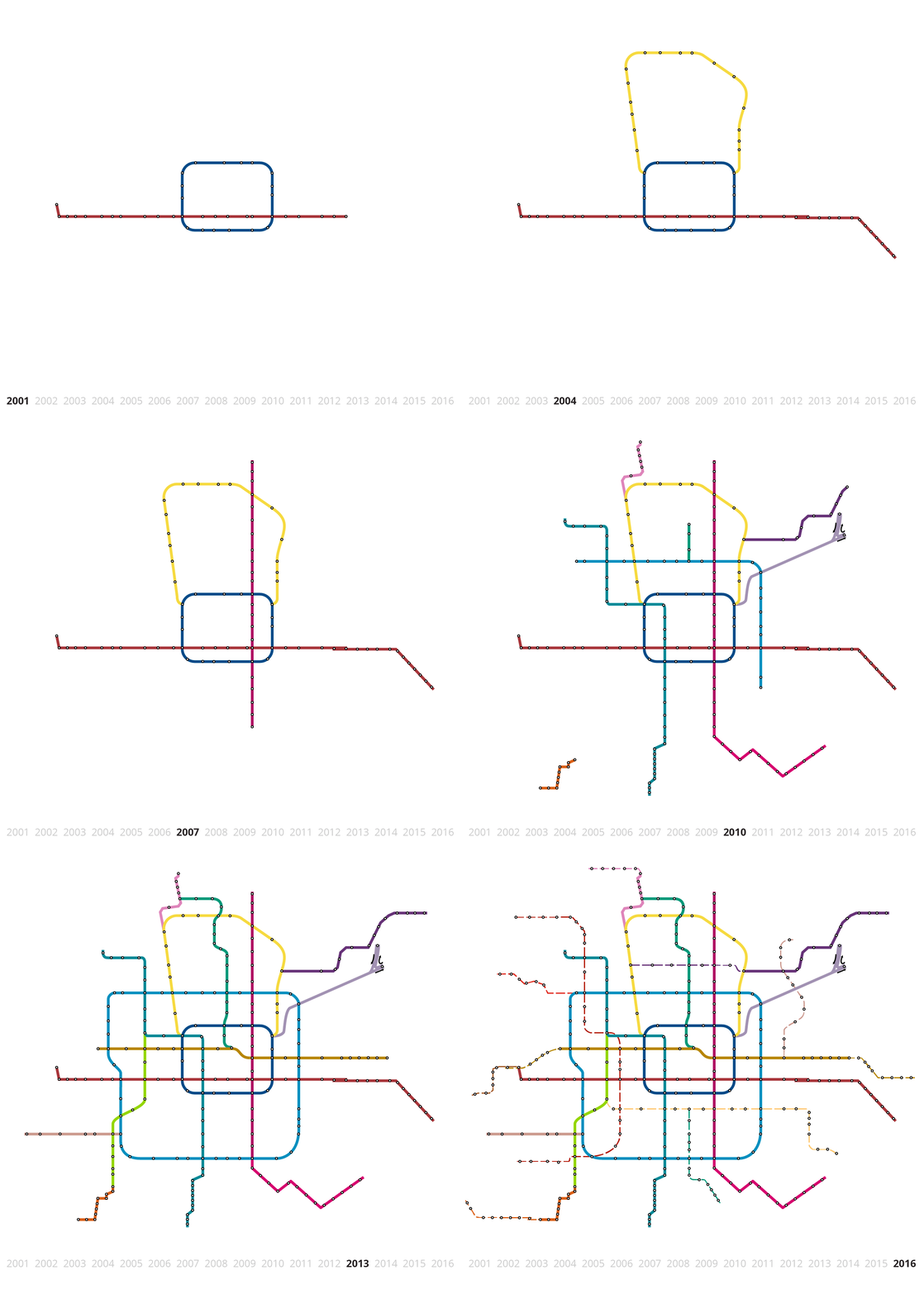
The expansion of the Beijing subway over the years. Graphic created by Hilary Fung and Alissa Scheller for this Huffington Post article.
To this list we can now add the Beijing subway. In this Huffington Post article, titled Beijing’s Incredible Subway Expansion In One GIF, journalist Matt Sheehan shows the incredible expansion of the Beijing Metro over the past decade (see animated GIF). He explains it took the Chinese only seven years to add several new routes, covering a length greater than the entire New York City subway system.
Sounds impressive? Let’s put some further perspective on those numbers by considering the fate of the founders of New York*: the Dutch.
As a Dutchman, I wasn’t sure if I should laugh or cry about Beijing’s Underground accomplishments. The capital of The Netherlands has been struggling to add one new subway line (the so-called “Noord/Zuidlijn”) since 1968, when the plan was first proposed. There have been riots, accidents, investigations, delays, more investigations and even more delays. For all those troubles, the people of Amsterdam have gotten a line which is still not finished today and 2.5 billion dollars over budget. Current hopes are for a completion by 2017, but this is far from certain**.
Meanwhile, in China.
Beijing must have decided to expand its subway network around the year 2001, when it got awarded the 2008 Olympics. Since then, it has added close to 300 miles of metro tracks, with another 320 miles to be added by 2020. That’s an average of roughly 30 miles per year.
Doesn’t sound like a lot? Let me tell you the length of the plagued Amsterdam subway line.
Are you ready?
Six miles.
Yeah, you can read that again, it’s not a typo. It’s taking my country 20 years to do what the Chinese do every 12 weeks. Here’s what that looks like visually:
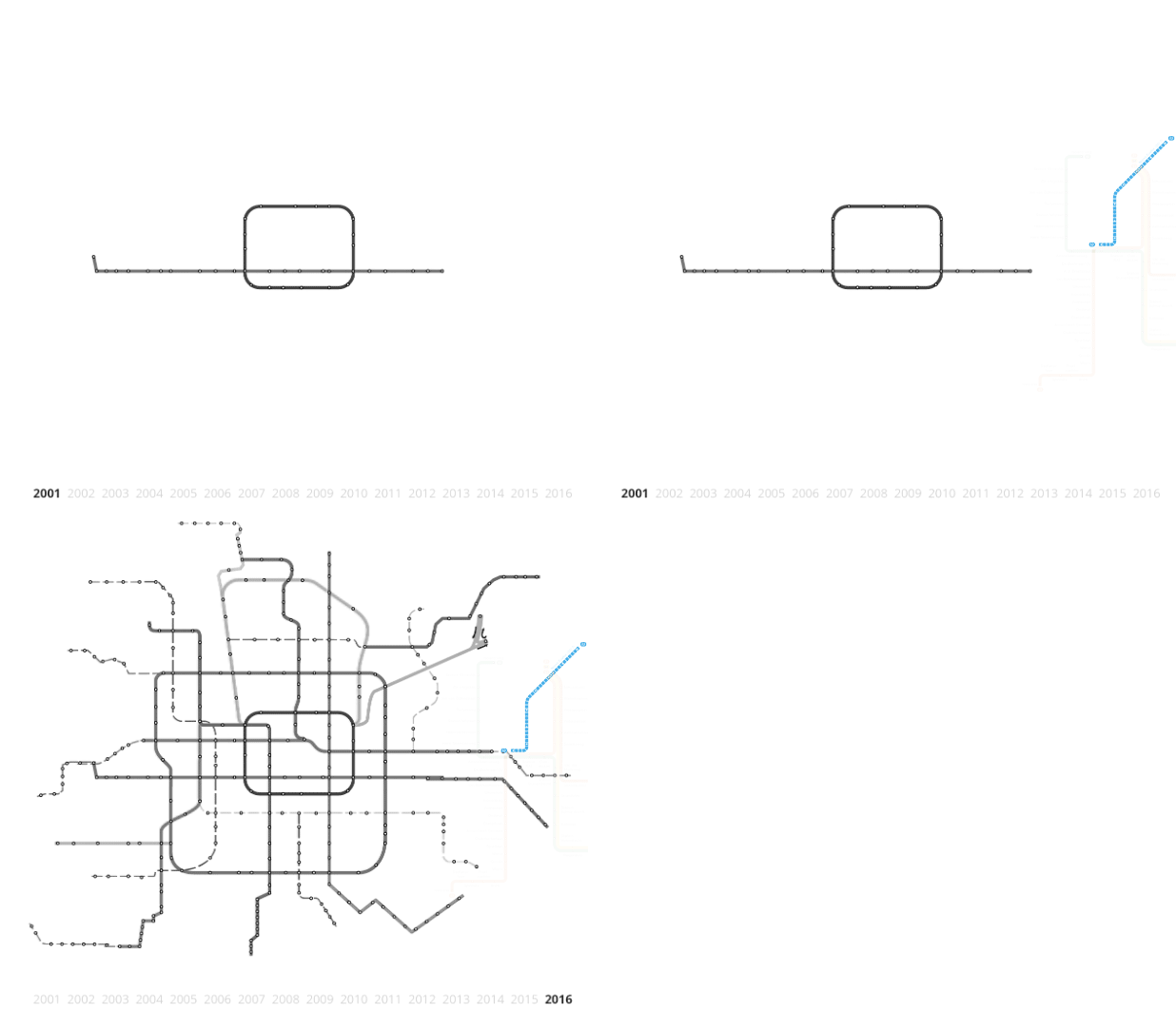
The blue line represents the line Amsterdam is building. The change in grey lines shows what the Chinese have added in the same time period.
It’s easy to spin this comparison into all kinds of directions. Let’s consider some headlines:
- Democracy is broken: Amsterdam subway construction delays prove it.
- The Dutch unfairly accused of poor performance: Chinese have millions of cheap labourers for their Underground expansion.
- Chinese can do in 2.5 months, what the Dutch do in twenty years. But Beijing doesn’t have to care about human rights.
- Holland versus China: here are the real results of different types of governing.
- The price of freedom: twenty years delay to build a tiny subway line.
I’m sure you can come up with others. Whatever ethical or political views suit you, the point is that the Chinese are getting things done and making progress at breakneck speed. Just imagine the Beijing metro expansion being executed the Amsterdam-way: at a rate of 0.2 miles per year, the Chinese would have to wait a whopping thousand years for their new subway lines. Expected year of delivery? 3015.
——
Footnotes
** New York was originally founded by The Dutch and called “New Amsterdam”. This was changed when the British conquered it and renamed it “New York”.*
*** Though construction might be completed by 2017, there are already worries about IT infrastructure and security issues. Fixing those might take several more years and delay the completion of the project even further.*
China facts from:
- http://www.factslides.com/s-China
- http://www.businessinsider.com/mind-blowing-facts-about-china-2014-6?op=1#ixzz3NjEzltvC
- https://www.chinaabout.net/multimillionaires-in-china-reaches-700000/
——
Beijing subway construction details:
- Between 2007 and 2014, Beijing added 235 miles of new subway tracks;
- Currently (early 2015) Beijing’s subway network is 327 miles long;
- In 2001, it was only 32 miles;
- In 2007, still just 84 miles;
- By 2016, Beijing is expected to have 406 miles of subway tracks. In 2020, 621 miles.
- The Beijing subway carries 10 million passengers per day, adding up to 3 billion per year.
Amsterdam “North/South” subway line construction details:
- Initially mentioned in planning proposals in 1968;
- Because of protests and riots in 1975 delayed;
- In the 80’s the proposal was revisited;
- This resulted in a decision to move ahead on 27th of November 1996;
- In a public referendum on 25th of June 1997, 64.8% of voters were against the construction;
- Because of certain legal requirements, that wasn’t sufficient to stop the construction;
- From 1997–2002 construction tests were done, because using a drilling tunnel was new and Amsterdam’s weak foundations were a concern;
- On 9th of October 2002, the final decision to move ahead was taken;
- Actual construction started April 2003. At the time expected delivery year was 2011, at a cost of 1.46 billion euros;
- Total length is 9.7 kilometres (6 miles);
- The line should carry 180,000 passengers per day;
- Now expected to be delivered 2017, total costs 3.1 billion euros.