The Rules of the Game
Post #5, 2014.10.13 | Prologue
Every serious publication has a set of rules to aid their writers. Most have a style guide to clarify how to write and editorial guidelines as to what topics are on and off limits. Here an excerpt from the Economist’s Style Guide*:
The first requirement of The Economist is that it should be readily understandable. Clarity of writing usually follows clarity of thought. So think what you want to say, then say it as simply as possible. Keep in mind George Orwell’s six elementary rules (“Politics and the English Language”, 1946):
- Never use a Metaphor, simile or other figure of speech which you are used to seeing in print.
- Never use a long word where a short one will do (see Short words).
- If it is possible to cut out a word, always cut it out (see Unnecessary words).
- Never use the Passive where you can use the active.
- Never use a foreign phrase, a scientific word or a Jargon word if you can think of an everyday English equivalent.
- Break any of these rules sooner than say anything outright barbarous (see Iconoclasm).
Sometimes these rules are public (as in the above example), oftentimes they’re not. As I’m a secrecy-agnost**, you’ll find my writing guidelines for this blog below***.
1. Honesty
Ever since reading “The Surprisingly Large Cost of Telling Small Lies”**** by Rebekah Campbell earlier this year, I’m trying to apply the maxim of “complete honesty about everything” to all aspects of my life (more on this soon). Naturally my writing will follow suit.
2. Learning
Can’t provide a 30 day money-back guarantee on this one, but I hope you’ll always gain something from reading a post. A laugh, a new word you’ve learned, an interesting further read, a dose of inspiration or simply a new perspective.
3. Frequency
There will be no minimum post rule, e.g. “at least one post per day”. Quality over quantity. But “backstage”, there will be a target for me to hit: write at least 45 minutes per day, six days per week*****.
4. The long run
One great advice out of many from my first boss and mentor:
“When everyone else stands still, you run. When everyone else runs, you stand still.”
Since most of the internet (and the world for that matter) seems to be running, I’ll be taking my time here, as you can tell from this prologue. It’s not a maximize-page-views-sprint, but a marathon towards achieving great writing and thinking instead.
5. Anecdotes
I’ll strive to include at least one anecdote in each article, to enliven whatever point I’m trying to make.
6. Quotations
I’m a sucker for great quotations, so you might run into one every now and then. If you hate quotations, just ignore them.
7. Independent
Like a sitcom, each post should be readable individually (unless marked “part x of y”), but consuming the whole should make the experience better and more meaningful.
8. External references (links)
A great aspect, and probably one of the core foundations of the Web, is hyperlinking. It encourages discovery and allows easy attribution of sources. Unfortunately, “research continues to show that people who read linear text comprehend more, remember more, and learn more than those who read text peppered with links.”****** I’ll therefore refrain from including links in the main body of my texts, but will instead place them as footnotes below each article.
Now let’s get down to business.
— — —
** You can check out the complete Economist Style Guide on* this page.
*** I believe information should be open and transparent, unless proven otherwise in specific cases. This is not the same as believing ALL information should be public and a secret never serves any purpose (which would make me anti-secrecy or an asecretist). In some cases secrecy is justified, though in most cases, individuals, organisations and societies would benefit from full transparency.*
**** These guidelines show how I approach my writing and compositions of articles here. They’re not exactly the same as a traditional style guide (like the one from The Economist) or editorial guidelines. The topics and how they will be categorised have been (briefly) explained in the first post titled “How to Start a Blog”.*
***** “Complete honesty is the access to ultimate power” from “The Surprisingly Large Cost of Telling Small Lies” by Rebekah Campbell, published in the New York Times.*
****** Some productivity freaks swear by “Non-Zero days”, every day, as* preached here on 99U. Though I’ve followed this practise for almost a decade (before the term “Non-Zero days” was invented), I’ve recently come to believe otherwise. Having at least one day per week with no (digital) work activity whatsoever, is much more beneficial for those other six days of the week, regardless of how busy you are.
******* Though I by no means agree with Carr’s overall negative view on the effects of the internet, he does raise a lot of valid points that deserve attention concerning distractions and focus. The problem of hyperlinks is well explained in this Wired article from his hand, titled “The Web Shatters Focus, Rewires Brains”.*
Other references
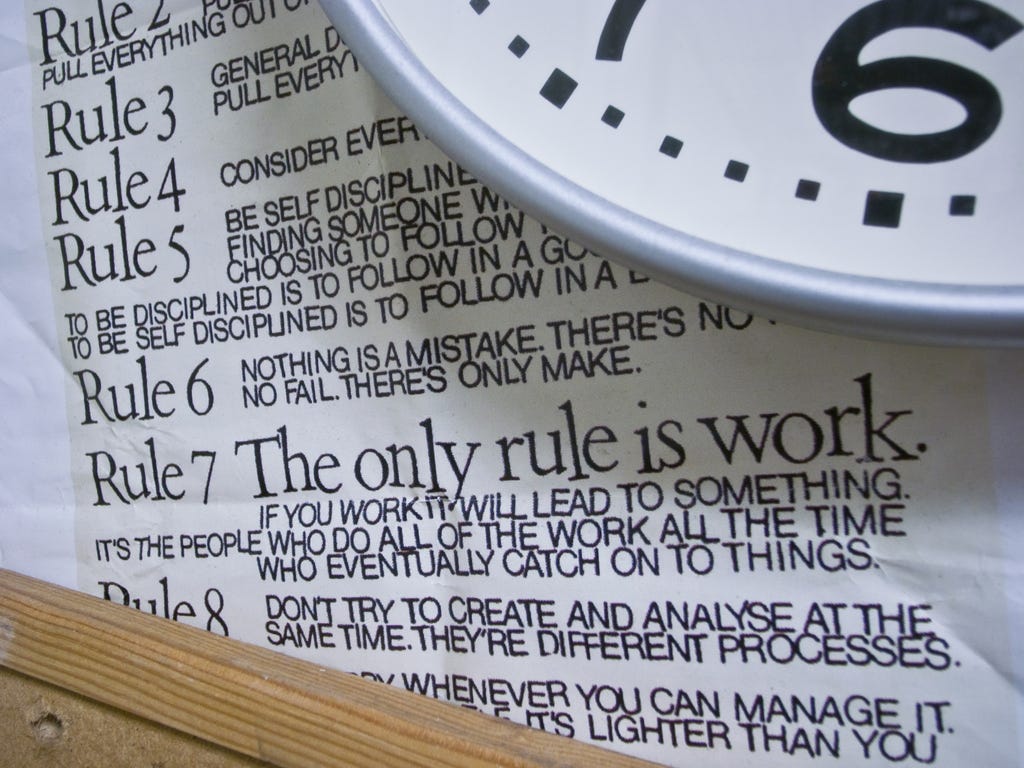
- Header image credits: “the only rule is work”, Flickr photo by Caren Litherland, under Creative Commons license. No changes made to original picture.
- Backstage: ** adv. In or toward the area behind the performing space in a theater, especially the area comprising the dressing rooms.* ** adv. In secret; privately.* ** adj. Of, relating to, occurring in, or situated behind the performing area of a theater.* ** adj. Concealed from the public; private.*
- Sitcom: a situation comedy.
Related posts
To Constrain, or Not Too Constrain?
Prologue | Post #4, 2014.10.11