Throwing Rocks at The Google Bus: book review
How Growth Became The Enemy of Prosperity
Author: Douglas Rushkoff
Genre: nonfiction; business, society, economics, finance, investment
Rating: 4/5
In one sentence: find out what’s wrong with capitalism and modern society, and what to do about it.
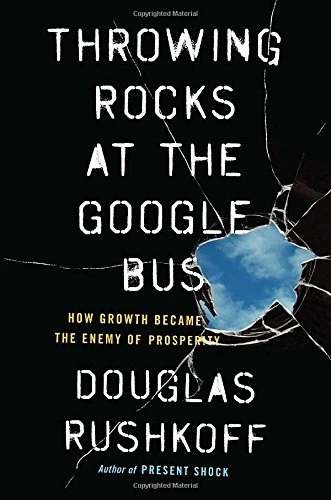
Throwing Rocks at The Google Bus book cover
An ear-catching title, that’s for sure. With Google’s “don’t be evil” mantra, why would anyone want to throw rocks at their busses? Curiosity sparked.
Out of all the offenders making an appearance in Douglas Rushkoff’s book, Google is actually the nicest bad guy (he acknowledges that for Google’s IPO, they bypassed the bankers and gave the general public “a first crack at its shares”, not common practice). Highest on his crook list are venture capitalists; pushing for astronomical valuations, they squeeze the original, lofty visions out of juicy startups. The investors force the founders to pivot their way to an IPO, or crash and burn while trying to get there (the latter being much more likely). As the author comments: “It’s not that Twitter isn’t successful; it’s just not successful enough to justify all the money investors have pumped into it.”
This touches on a fundamental point of the book, and it goes far beyond the startup game played in Silicon Valley: the way corporations are setup and financed is rigged to benefit those at the top. Here’s Rushkoff in his own words:
“Industrialization was about restoring the power of those at the top by minimizing the value and price of human laborers. This became the embedded value system of industrialism, and we see it in every aspect of the commercial landscape, then and now.”
According to the author, the entire system of money, corporations, and investment has lost sight of the original reason for doing business: to create ongoing value for customers, employees, and owners. Instead, the existential goal now is growth at any cost, creating as much value as possible only for the owners.
Rushkoff points out this problem has gotten worse because of the digitization of corporations and markets. This has allowed ever smaller groups of people to control ever larger markets and capital. But in this development also lies reason for hope: when set up differently, our digital tools can allow people to exchange value directly, without needing a platform or middle man in between. From the book:
“We join and form businesses that value our real investments of effort, stuff, and community resources. Imagine an Amazon owned by the sellers, an Uber owned by the drivers, or a Facebook owned by the people whose data and attention is being bought and sold. Distributed digital technology makes this not only possible but preferable to the locked-down, overprogrammed, and extractive platform monopolies of today.”
This book goes much deeper than you might expect. It’s a call for restructuring not only the corporation but the entire monetary system. Some folks (notably bankers and venture capitalists) will certainly disagree with Rushkoff’s premise. Others will wholeheartedly agree and love to see this book’s vision for the future become reality.
> Throwing Rocks at The Google Bus
Sign up for the monthly Just Finished email (click here).
One simple email delivered to your inbox; each last weekend of the month, one great book and one amazing article recommendation.