We’re Planning to Raise $100k on Indiegogo: Here’s Our Entire Strategy
We’re Saent. We’re building a hardware device and companion application to help people do great work by being less distracted.
(UPDATE: Our Indiegogo campaign is over, but you can still order your Saent: http://igg.me/at/saent or you can download the free app here.)

The shape of the Saent device is based on a drop of honey.
The web is equally littered with post-mortems of utter failures as well as grand success stories. Open up Medium on any given day and you’ll run into several home run wonder stories, balanced with at least as many tales of unfortunate startups, products and crowdfunding campaigns that went belly up.
While it’s great to be able to learn from those insights, they all suffer from one flaw: hindsight bias.
“Hindsight bias occurs when we look backwards in time and see events are more predictable than they were at the time a decision was made. This bias, also known as the ‘knew-it-all-along effect,’ typically involves those annoying ‘I told you so’ people who never really told you anything.” - Shane Parrish, Farnam Street
It’s easy to see what you did right or wrong after the fact. Brilliant moves might get overemphasized, mistakes blown out of proportion. To avoid this bias, we’re going to share our entire crowdfunding strategy now, before our actual campaign launches.
Strategy?
Let’s first make sure we’re all on the same page. Here’s how professor Richard Rumelt, author of Good Strategy / Bad Strategy, sums up the concept of strategy:
“Strategy is a cohesive response to an important challenge.”
He goes on to define bad strategy:
“Bad strategy is not the same as no strategy or strategy that fails rather than succeeds. Rather, it is an identifiable way of thinking and writing about strategy that has, unfortunately, been gaining ground. Bad strategy is long on goals and short on policy or action. It assumes that goals are all you need. It puts forward strategic objectives that are incoherent, and, sometimes, totally impracticable. It uses high-sounding words and phrases to hide these failings.”
With these definitions in mind, we’ll lay out our approach for reaching our goal: raising at least $100,000 for our upcoming product through crowdfunding.

A top down shot of the Saent productivity hardware and software in action.
Our challenge
The main reward tier we will have available during our campaign is $39 (excluding shipping). For this, you will get:
- Our device for on your desk, which can be best described as a physical button that connects to your computer through Bluetooth. When pressed, it communicates with the software and launches a timed, focused work session.
- A 1 year Premium subscription to our software, which blocks distractions, allows you to work in sprints (à la Pomodoro Technique and other common work rhythms) and gives you points for completed focused blocks of work.
To simplify, let’s assume most people will go for this reward tier. In this case, we will need 2,600 backers to purchase this package. However, when we first started working on our strategy in mid-April, we only had 1,600 people on our weekly mailing list, with an average open rate of 25%. We would need those 400 people to buy 6.5 devices each, a conversion rate of 650%…
“Impossible is nothing.” - Aleksey Vayner
According to Indiegogo, a normal conversion rate from your mailing list is 5%. If we want to ensure we reach at least half our minimum goal from our email contacts alone, it means we’d have to grow to approx. 25,000 subscribers. With our target launch date in early July, that was no short order.
To put that challenge in perspective: it took Ryan Holiday almost four years to grow his book recommendation reading list from zero to 15,000. This would mean we’re doomed. On the other hand, Harry’s, a men’s grooming brand, gathered 100,000 email addresses in one week with the help of Tim Ferriss. Maybe it could be done?
Our unfair advantages
“A good strategy is an approach that magnifies the effectiveness of actions by finding and using sources of power.” - Richard Rumelt in Good Strategy / Bad Strategy
Though we don’t have any best-selling authors on board to assist us, we do have a few unfair advantages:
- Indiegogo partnership: to my shock and amazement, the crowdfunding platform approached us in the run-up to our campaign. They sometimes do this with products they believe can be very successful, to maximize the potential of the campaign (and, of course, increase their 4% cut along the way :)). This has many advantages, one of them being an Indiegogo campaign strategist assigned to us, to ensure everything is in place for a successful launch.
- Media connections: from this ad on Growthhackers.com, Josh Catone found us. Having been at Mashable for five years, as well as heading up marketing at Feedly for a while, Josh has good relationships with blogs, media and other companies that are so inundated with daily communications that they might never notice cold emails from an unknown startup called Saent.
- Seed investment: we were lucky enough to convince an angel investor of the potential of Saent early on. This allowed us, amongst other things, to bring onboard a Growth Hacker, embark on a promotional and research trip through the USA and have a huge head start on product and software development in advance of launching our campaign.
- Personal networks: several of us have pretty vast personal networks. According to the six degrees of separation theory, we should be be able to reach a substantial part of our relevant target audience (see below) with a perfectly executed referral campaign.
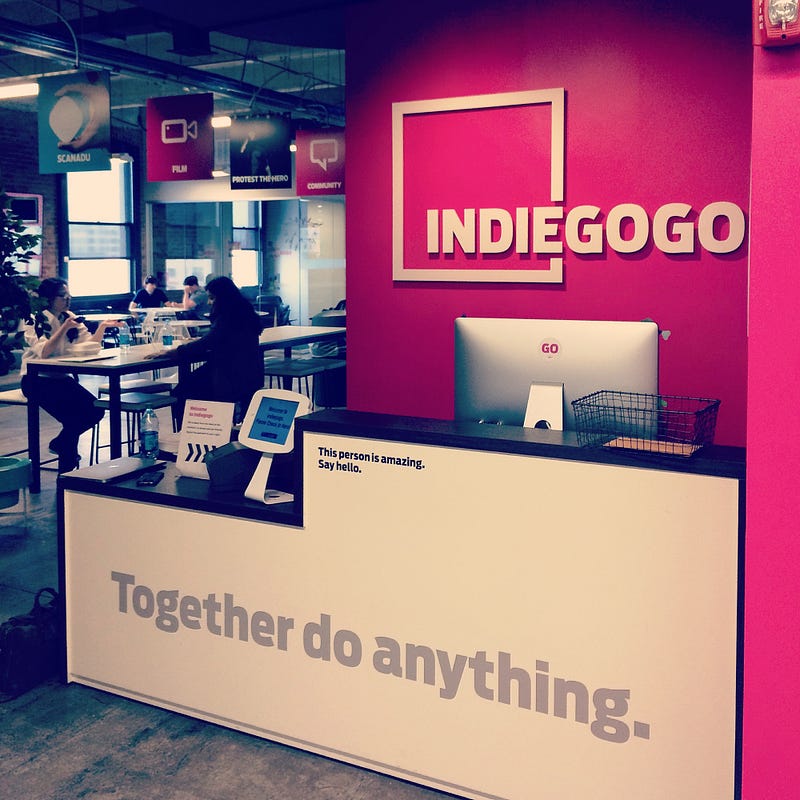
The Indiegogo offices in San Francisco (USA), where we further discussed our partnership.
Gearing up for the challenge
When it comes to marketing a crowdfunding campaign (product fulfilment is a different story), you can simply divide the process into two phases: pre-campaign and (during) campaign.
For us, the pre-campaign objective was getting to 25,000 email addresses. The campaign goal is to reach at least 2,600 backers with an average spend of $39.
In putting together a plan for these different phases, the Indiegogo partnership immediately paid off. Rachel, our campaign strategist, had some valuable insights that ran contrary to our initial intuitions:
- “Don’t do your press outreach until you’re at 30–40% of your funding goal. This will lead to higher conversion from people coming in ‘cold’ through media.” This is the reason we need 25,000 people on our mailing list: to reach 30–40% as quickly as possible after launch.
- “Reduce the number of perks you have.” From reviewing other campaigns and assuming more choice is better, we concluded many perks equals good. Rachel pointed out the Paradox of Choice also applies to crowdfunding.
- “Make sure your video shows the product and your team in the first 30 seconds, you can explain the problem you’re solving later.” This is exactly the opposite of what we did; we opened with the problem in our original video (box download link). Feel free to compare with the final one below.
Our final crowdfunding pitch video.
*Assessing our strengths* When we took another look at our overview of strengths, only two of them could be applied to our pre-campaign objective of collecting 25,000 email addresses.
Besides providing helpful feedback and advice, Indiegogo’s marketing algorithm might select us for their newsletter and social media channels once the campaign is live, but not prior to launch. And as Rachel suggested, Josh’s attempts to land us media coverage shouldn’t come into play until we’ve reached 30–40% of our funding goal. This leaves growth hacking and our personal networks.
*Growth hacking* Growth hacker has become an overused and often misapplied term. But for our purposes, we’re going to use the definition provided by Gagan Biyani of The Next Web:
“Growth hackers utilize analytical thinking, product engineering and creativity to significantly increase their company’s core metric(s).”
In other words, a growth hacker is a rare hybrid of marketer, product designer and analytics expert. He views the world with different eyes, always looking for opportunities to “game the system” (through legal and, usually, morally acceptable practices) to increase conversion towards an objective.
In our pre-campaign case, this meant:
- Where could we find untapped sources of potential users for our product?
- How could we maximize leverage from our existing networks?
*Untapped sources* As any marketer or lean entrepreneur will say, you need to define a clear target audience in order to know where to start looking for potential customers. Everyone and their dog is on the internet these days, so untapped sources are endless. Unless you know what you’re looking for, it’s like looking for a needle in a haystack.
From the product research we conducted over the past few months, two groups rated strongly:
- Remote workers: people who do “work completed in an environment other than the employer workplace.” Because they’re by themselves, remote workers tend to struggle more with productivity issues: there’s no boss to impose schedules, nobody to check whether you’re drifting off to Facebook again, and of course there’s your house to clean. In case they have colleagues back in the office, they also have a strong need to show they’re not “slacking off.”
- Startups: (young) people in startups suddenly become much more aware of both time and money being scarce resources. They need an edge to compete and productivity is one important ingredient to do so. Entrepreneurs are generally also interested in new products and technology, as evident by the popularity of sites such as Product Hunt. This makes it an excellent target audience for our productivity hardware and software solution.
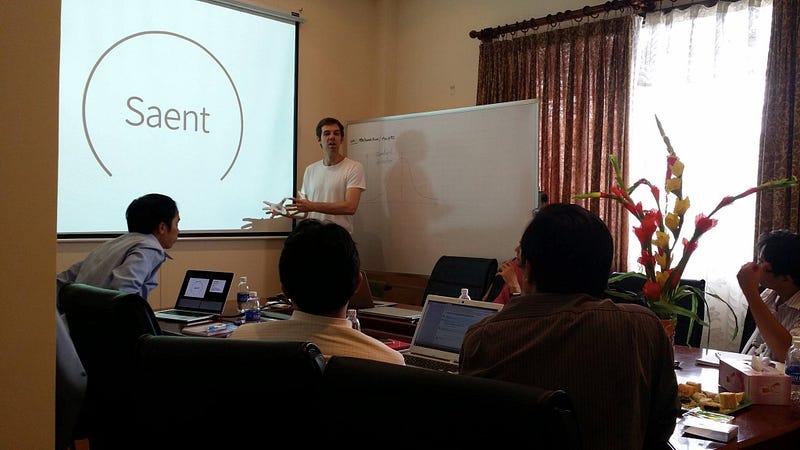
A meeting with the team in Vietnam to discuss the Saent software development.
With these two groups in our sights, we began to paint a picture of how to position ourselves and where to start looking:
- Remote working blogs and communities.
- Remote working companies.
- Productivity communities (e.g., on Reddit).
- Co-working spaces.
- Startup lists.
- Medium.
Personal networks** The other, and perhaps most important source of possible “leads,” are our own personal networks. As the founder of Harry’s, who managed to get 100,000 email addresses in a week, wrote about their pre-launch plan:
“The idea for our campaign was built around our belief that the most powerful and effective way to be introduced to our new company was through a credible referral. Thus, we focused on building a campaign that helped people to spread the word to their friends.”
This is of course textbook, sales 101 knowledge. Research shows a recommendation from a friend is still the most powerful marketing mechanism around. Harry’s skilfully tapped into this knowledge and executed perfectly with a simple, yet hyper effective campaign.
Our plan
“Everything should be made as simple as possible, but not simpler.” - Albert Einstein
Having identified the challenge, articulated our strengths and defined our target audience, the next step was to decide on the actions which would help us overcome our challenge and achieve our objective.
*Pre-campaign* This phase was the most crucial, but also the hardest to get right. We knew that if we nailed this, we’d be riding a wave that should carry us to the shore.
The key here is to throw out several lines in different ponds, without overstretching ourselves. Our plan was to carefully monitor where we caught the most fish and double down on that source; to empty it with a drag net.
Here are the different lines we tossed out:
- Copy Harry’s campaign structure: that’s right, I promised we’d be transparent, so I will not pretend it’s cleverer or smarter than that. We copied their exact mechanism and setup for our campaign (using a tool called KickoffLabs), except with different rewards to activate our personal networks.
- Target paid mailing lists:* we reserved some budget for gaining access to paid mailing lists for new startups and products on outlets such as: http://betalist.com/
http://startuplister.com
http://www.startuptabs.com/
http://startupli.st/
http://erlibird.com/
http://ideasquares.com/
http://killerstartups.com/
http://launchingnext.com/ - Rally online communities:* by posting or guest blogging on networks of coworking spaces, Reddit, job boards, ProductHunt and entrepreneurial online hangouts.
- Face-to-face promotion: having an online campaign doesn’t mean all outreach has to be virtual. We organized a meetup for remote workers in Beijing together with Remotive. To push the product, Tim also personally attended events and startups in the USA and met with influential entrepreneurs.
- Personalized outreach: by searching crowdfunding platforms and social media for people who have an interest in either #hardware or #productivity, we’ll personally reach out to people whom we think can benefit from our product.
** You can review our detailed traffic strategy plan for points 2 and 3 in* this Google Doc.

The first Beijing Remote Workers Meetup we organised together with Remotive.io
If this sounds like a lot of work, it was. So how did we avoid overstretching ourselves? Harry’s was kind enough to make all their templates and coding available to anyone. We’ve enlisted several Virtual Assistants to help us with research and mundane tasks. Josh focused on writing and optimizing copy, while Stephen automated as much as possible and measured results.
As data came in on which of the above methods and sources were most effective, we put all our resources behind those in our push for 25,000 subscribers.
*Campaign* During the 30-day campaign, we should be riding the wave created pre-launch to hit our goal of $100,000 in funding. But, we don’t want to take any chances, so there are several initiatives we’ll employ during our campaign to keep us riding high:
- Press outreach: shortly before we hit the 30–40% milestone, Josh will start reaching out to people in his network and attempt to place some articles and interviews about Saent in the tech media.
- Customized perks: as the campaign gets underway, we’ll start to receive feedback from backers and other people learning about Saent. Based on their input, we’ll tailor new reward offerings to their needs during the campaign.
- Customer support: with, fingers crossed, thousands of backers signing up for our product, we can be fairly certain there will be a good amount of incoming questions, feedback and, hopefully, ideas! To deal with this, we’re setting up a dedicated customer support service using Groove. Initially this will be manned by the existing team members, but, if the volume of requests becomes overwhelming, we’ll use one or more Virtual Assistants to jump in, along with some friends and family.
- Partnerships: depending on how successful our campaign will be, we can reach out to other productivity apps and blogs to provide special packages and promotion. (In fact, this is something we’ve begun doing already as part of our guest post outreach from the pre-campaign strategy.) Our solution is made to encourage use of other apps, not replace any of them. By showing there is sufficient interest in what we’re doing, others might be willing to come onboard halfway through the campaign and do cross-promotion.
- Commission: for a handpicked group of growth hackers and marketers, we will provide a commission of $2.50 per sold device through their referrals. This program is not open to the general public but can help us drive growth in countries and segments we would otherwise not have access to.
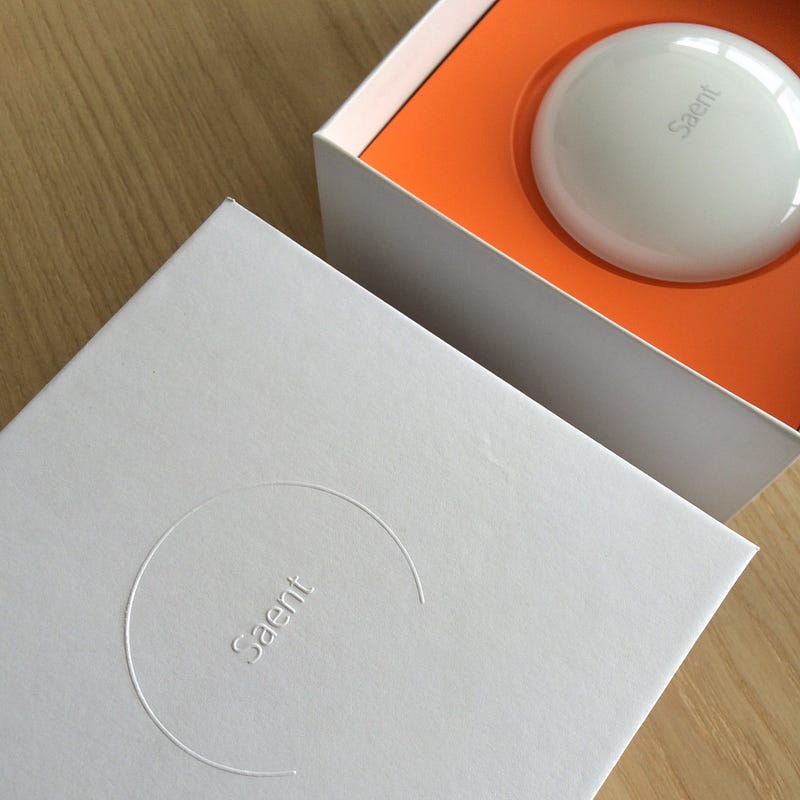
A Saent device ready and waitingto be backed by you!
What do you expect will happen?
The above includes enough predictions and assumptions to warrant a good laugh or cry when we review this one month from now. Nevertheless, let’s up the stakes a bit and some of Saent team members what they expect will happen.
Here are the questions we put forth:
- What total funding amount you think we’ll end up at?
- If somehow the whole thing crashes and burns (we don’t reach the target at all), what will have been the reason?
Christina: “I expect we’ll reach 200k. I believe we can go even higher. If we don’t reach our goal, it means we don’t know our community well enough yet.”
Fleur: “580K (I like lucky numbers). If we fail, people thought it would ‘infiltrate’ their privacy and freedom too much (a button telling them what to do…). This is the feedback I received from some people.”
**Josh: *“***Because we have a relatively low price point, I think millions will be difficult (not impossible, but maybe not likely). I’ll say $350k, which represents about 8,500 backers or so. I think we executed our strategy pretty well, so if we fail, I think it will be because we either overestimated the market (which runs contrary to all our user research) or we didn’t explain the value proposition well enough. Fingers crossed neither of those things happens!”
**Russell: *“***I have always had the 300k figure in my head…so 300k. Failure? Tough one, but maybe the need for the button being lost on people.”
Stephen: “I’m going to speculate that we exceed our goal, and if we do so, I think we’ll get to 200k or 250k, so my figure is 225k. If it crashes, I think it’ll be because we didn’t have a big enough day-1 list and we couldn’t get to 30–40% in the first few days. If you don’t get there, you’ll struggle to reach your goal at all, and we’re probably pushing a little bit earlier than preferred due to real world budget necessity.”
Tim: “Assuming we indeed get to our target of 25,000 email addresses, I believe we can end somewhere between $150,000 — $200,000 in funding, so I’ll pick $175,000. I see a worst-case scenario unfolding if there turns out to be a negative aspect in the product proposition we somehow overlooked; insider blindness but obvious to anyone on the outside.”
Ready… Set… Go!
That’s it, our entire strategy. We’ll do a follow-up on the above about midway through our campaign, to see how things are going. Then we’ll do a final wrap-up once we’ve reached the end.
In the meantime, I’d love to hear your feedback, good and bad, as well as any ideas you might have. It’s never too late to adapt and we’re always open to learn. Besides that, we’d greatly appreciate it if you support our campaign and help spread the word :) Just click here to get involved; thanks so much!
Ready to give Saent a try?
Download the free app now to start working smarter, being more focused, and developing better work habits.
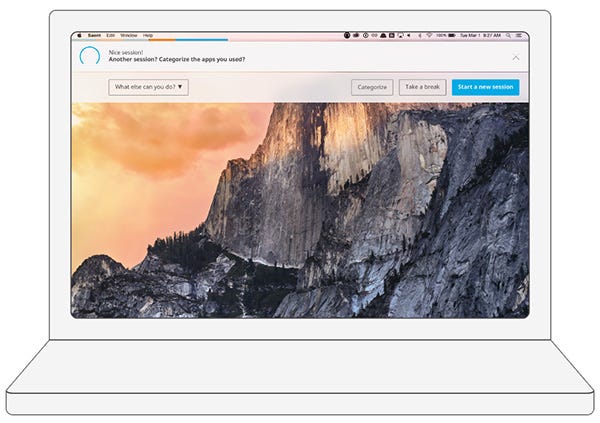
You can download the free version of the Saent app now by clicking the image above.
Or buy your Saent button (now shipping!) with a 12-month subscription to the Premium Saent app included!